EST. 2021 Antwerp, Brussels, Leuven, Liège & Remote Planning Q1 2027 engagements

Turn hard engineering questions into working systems.

Peinser is a European engineering team for work that crosses research, platform engineering, and aerial robotics. We help you choose the right approach, prove it, and put it into operation.

01 — Practice

Research & development.

Applied research, machine learning, and engineering R&D for questions without an off-the-shelf answer. We produce reproducible prototypes, peer-reviewable results, and a clear path from evidence to production.

Applied ML · Data & modelling · Lit reviews · Co-publications
02 — Practice

Platform engineering.

Distributed systems, cloud infrastructure, CI/CD, and observability for teams whose platform has become a delivery constraint. We design the target, ship the first production slice, and leave your team able to run it.

Distributed Systems · IaC · Kubernetes · CI/CD · SRE & Observability
03 — Practice

Aerial robotics.

Mission planning, ground-station software, airframes, and autonomy integration for UAV teams that need field-ready systems rather than another disconnected prototype.

Mission planning · Ground stations · Airframes · Autonomy integration
04 — Practice

Strategy & direction.

Technical audits, discovery, and decision memos for teams facing an expensive or difficult-to-reverse choice. We make the options, evidence, costs, and risks explicit before you commit.

Technical audits · Decision memos · Roadmaps · Second opinions
— 01 / Robotics

Mission planning and operations for UAV teams.

We build the software between a mission brief and a vehicle in the air: terrain-aware planning, operator interfaces, vehicle integration, and the field tools needed to keep the system working.

Flightdeck planning a terrain-relative fixed-wing survey, with the estimated flown path and terrain altitude profile visible.
Flightdeck terrain-relative survey planning, estimated flight path, and altitude profile.
— Practice 03 / Aerial robotics

UAV systems operators can use.

We build browser-based planning and ground-station software, integrate autonomy and perception, and design airframes around the operation. The goal is not a collection of demos, but a system your team can test, understand, and take into the field.

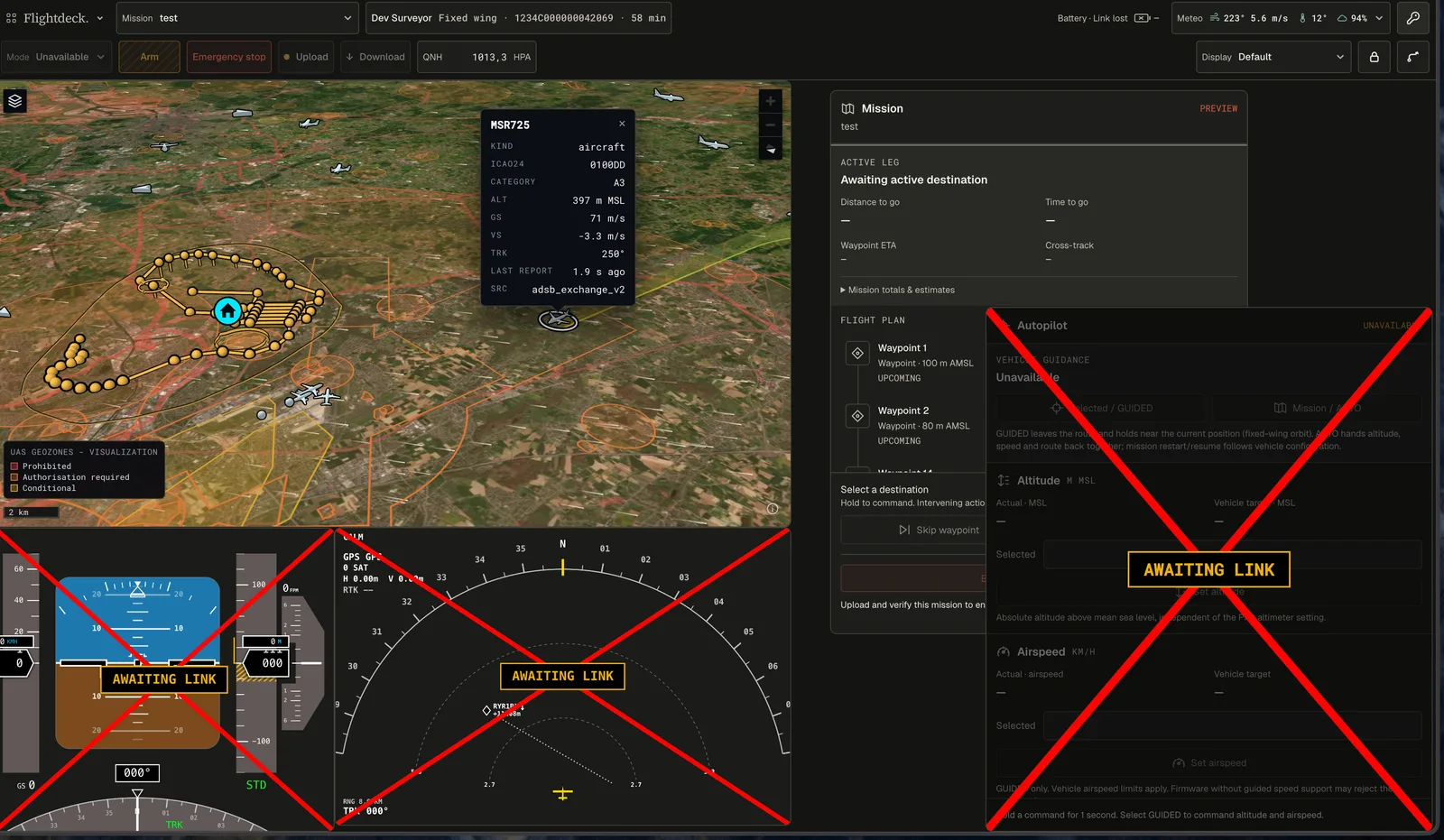
  • Mission planningWaypoint, loiter, survey, geofence, and rally-point workflows with terrain-aware altitude handling and estimated flight paths.
  • Live operationsFlight instruments, mission progress, vehicle health, traffic, video, and acknowledged command workflows in a browser-based cockpit.
  • Field toolsFirmware, RTK, radio, parameter, and vehicle-file workflows brought into the same browser workspace.
  • Machine learning at the edgeOn-device perception, anomaly detection, and model deployment for constrained vehicle hardware.
  • Airspace awarenessADS-B, Remote ID, and other detection tracks brought into a single operator picture.
  • Autonomy integrationROS 2, ArduPilot, PX4, MAVLink, and custom vehicle interfaces. We work with the stack you already fly.
— 02 / Method

Start with a focused six weeks.

Long enough to resolve the important uncertainty. Short enough to act on the result. We agree the question and decision criteria up front, then finish with evidence, a decision, and a working first slice where appropriate.

01 — Phase

Discovery.

Read the literature, the code, the data, and the runbooks. Talk to operators and end users. The deliverable is a findings memo with explicit assumptions and open questions.

WK 1–2 · Findings memo
02 — Phase

Decision.

A small set of options, each with a cost, a risk profile, and an owner. We choose together; the choice — and the rationale — is the deliverable.

WK 3–4 · Decision memo
03 — Phase

Ship.

Put the decision in front of real users, real infrastructure, or a representative flight environment. The output is a thin, instrumented slice and a concrete plan for what follows.

WK 5–6 · Working first slice
The hardest engineering decisions are rarely about what to build. They are about what to keep running, what to deprecate, and which version is worth the cost of operating. — Internal note · Wk 03 · Aerial inspections engagement
— 03 / Projects

Products and platforms.

Products we build from recurring engineering problems. Try the public tools, inspect the open-source work, or talk to us about deploying them in your operation.

Product · UAV operations Prototype

Flightdeck

Plan, inspect, and operate UAV missions from a browser-native ground station.

Flightdeck combines terrain-aware planning, estimated flight paths, live operations, verified mission upload, and browser-based field tools. It flags potential clearance conflicts, incomplete terrain coverage, and unsatisfied waypoints while the mission can still be corrected.

Designed as a per-vehicle endpoint within Tower; automated provisioning and command-authority enforcement remain integration work. A free standalone planner and supported SiK and u-blox RTK tools run without the backend.

Terrain-aware planning · Estimated flight paths MAVLink · QUIC · RTK · SiK
Try the free standalone planner →
Open source · Geodesy Live · v0.8

CORSHub

A federated CORS / RTK network for centimetre-grade GNSS.

An auditable community network of base stations that broadcasts RTCM corrections to anything with an RTK receiver; surveyors, agricultural rovers, and our own drones. Open protocol, open data, federated by design.

github.com/peinser/corshub MIT · NTRIPv2 · Open Policy Agent
Project site →
Open source · Networking Pre-1.0 · MVP

quic-sni-router

A small QUIC SNI router for pod-terminated mTLS and HTTP/3 services.

Reads the SNI from incoming QUIC v1 and v2 packets and forwards the original datagrams, untouched, to the right backend pod. TLS, mTLS, and HTTP/3 termination stay in the application; the router is one UDP ingress in front of many QUIC services. Built for Kubernetes, configured in YAML, fuzzed and containerised.

github.com/peinser/quic-sni-router Apache 2.0 · QUIC v1/v2 · HTTP/3
Project site →
Hardware · Catalog Shipping

Airframes

A small catalogue of drones, built to fly with our software.

Three reference airframes; a long-range FPV quad, a long-endurance fixed-wing, and a heavy-lift inspection platform. Open BOMs, open firmware, optimised for swarm flight against our ground station. Buy one, or build your own from the spec sheet.

3 airframes · €4.2k–€18k ArduPilot · Betaflight · PX4 · OpenPilot · OpenFOAM CFD
Product · Documents Live · v1.0

Xarta

A document protocol for the full lifecycle: render, sign, archive, dispatch.

Teams repeatedly rebuild the same document plumbing: rendering PDFs from templates, versioning templates, signing output, assembling bundles, dispatching Peppol invoices, and archiving records for the required retention period.

Xarta consolidates the lot behind a DAG protocol. The submitter declares the flow; Xarta executes it deterministically. Plug-in template engines, templates versioned in git rather than locked in a vendor UI, Peppol BIS 3.0 in the same pipeline as everything else. On-prem by default.

On-prem · Peppol BIS 3.0 · Document Lifecycle Template Rendering · PDF/A · PAdES
Spin-out · Energy · EV Charging In market

Zonnetanken

Smart EV charging that follows the sun.

An open charging network with auditable sessions for employee cost recovery. Started as a side project; now an independent product with paying users across Belgium. Its OCPP interface gives operators control of their charging infrastructure, data, and workflows.

zonnetanken.be Web · OCPP · Alfen · Peblar
Visit Zonnetanken →
— Selected clients
Acerta ULiège Innovatix Duvel Logistics H.Essers Van Cleven NV
Planning Q1 2027 engagements

Bring us the problem before the specification.

Tell us what is uncertain, what you have tried, and what a useful outcome would change. In the first conversation, we will test whether we are the right team and outline how we would approach the work. No prepared brief required.